

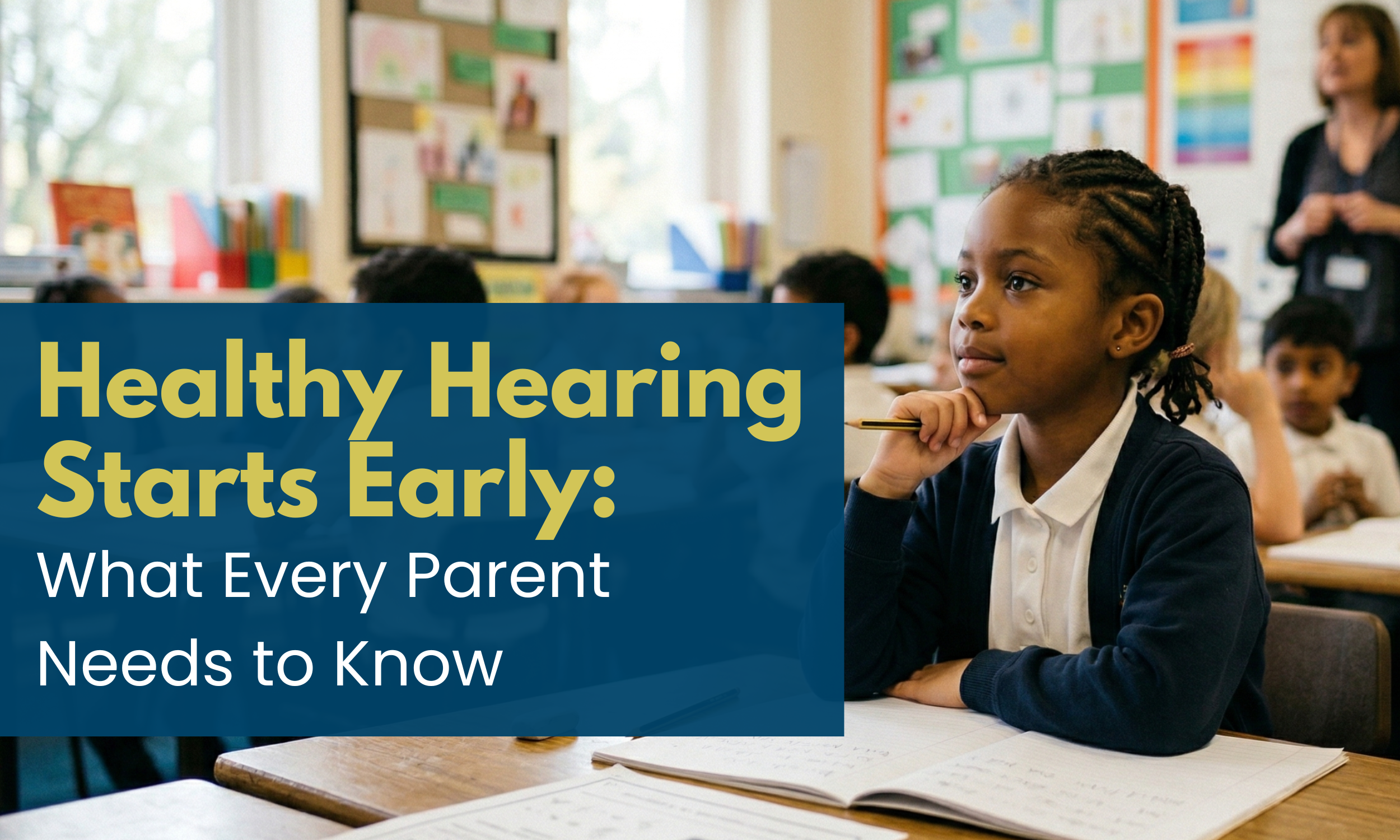
Your child is bright, engaged, and perfectly capable of answering you when you are standing right next to them. But at school, the teacher says they seem distracted. They come home more worn out than the day seems to warrant. They ask "what?" a lot, and not just when the TV is on. They seem switched on one-on-one but get lost when there is a group conversation or a noisy room involved.
You have probably chalked it up to tiredness, or a busy classroom, or just their personality. And you might be right. But sometimes there is something else worth looking at, and it is simpler to check than most parents expect.
Children's Hearing Health Is About More Than Responding to Sound
When most people think about a child's hearing, the image is straightforward: can they hear a sound? Yes or no. But hearing health in children is much more layered than that, and understanding the difference matters.
Hearing underpins how a child takes in language, follows instructions, and makes sense of what is being said when there is noise and movement all around them. It feeds directly into how they participate in class, whether they feel confident enough to put a hand up, how much energy they have left at the end of a school day, and how clearly they can focus when a lot is happening at once.
When hearing is working the way it should, a child does not think about it at all. When it is working harder than it should, even in subtle ways, that effort has to go somewhere. It shows up in their behaviour, their tiredness, and how present they can actually be in the environments that matter most to them.
Why a Child Can Seem Fine at Home and Struggle at School
This is the part most parents do not expect, and it is important.
Home is a naturally easy listening environment. It is quieter than a classroom, more predictable, and without thinking about it, parents face their child when they speak, repeat themselves, and slow down when something does not land. The environment compensates, and nobody notices it happening.
A classroom is the opposite. It is one of the most demanding listening environments a child will encounter: chairs scraping, other children talking, a teacher's voice projecting from across the room, and the expectation that your child follows every word, all day, without losing focus. A child who hears well in a calm one-on-one moment at home can find that same task genuinely hard work in a busy classroom. Not because something is wrong with them, but because listening is taking more effort than it should.
This is often connected to auditory processing skills and development, though it can also be the result of a permanent hearing loss. The signs can sometimes overlap, which is exactly why a proper assessment matters. We can separate these conditions and build a clear picture of how a child processes speech and language in noise and whether they have full access to the nuances of sound and language around them.
That extra effort has to come from somewhere. It typically comes from the energy that should be going into learning, participation, and confidence.
Signs Worth Looking Into, Not Panicking About
None of what follows is a definitive checklist or a cause for alarm. These are everyday moments worth noticing, especially if several feel familiar. For something more structured, we have formal questionnaires regarding your child’s listening behaviours and effort levels that can be completed by parents or shared with teachers. Reach out to admin@hoffmanaudiology.co.za and we will send those through to you.
A child whose hearing is working harder than it should might:
Ask "what?" or "huh?" more than seems normal, especially in busier or noisier situations
Come home from school more exhausted than the day seems to explain
Cope well one-on-one but drift or seem lost in group conversations
Miss parts of instructions, particularly when there is background noise or a lot happening at once (or the teacher says your child has difficulty following complex instructions)
Be described by teachers as inattentive or easily distracted, even though they engage well at home
Get frustrated in situations that require sustained listening, without being able to articulate why
Hearing is one piece of the puzzle, not the whole picture. But it is a piece that is easy to check and worth ruling in or out.
What a Full Hearing Assessment Actually Involves
A paediatric hearing assessment at Hoffman Audiology is thorough, calm, and completely child-friendly. It is not a quick screen and it is not a box-ticking exercise. It is a proper 360-degree look at how your child hears, processes sound, and copes in the real environments of their life, including the classroom, the playground, and the dinner table.
We take the time to understand the full picture, not just the test results. For most children, it does not feel clinical at all. And whatever comes out of it, whether that is reassurance, a clearer understanding, or a pathway toward support, you leave knowing more than you did when you walked in. That is always a better place to be.
KZN school holidays are here and term 2 is not far off. This is a practical window to find out where your child's hearing is at, with no school days missed and no disruption to their routine. If something has been nagging at you, this is a good time to act on it.
Book a conversation with one of our Audiologists at Hoffman Audiology in Durban (Musgrave Park) or Ballito. Come in and find out where your child's hearing is at, before the new term begins.
Because healthy hearing starts early. And so does everything it supports.